
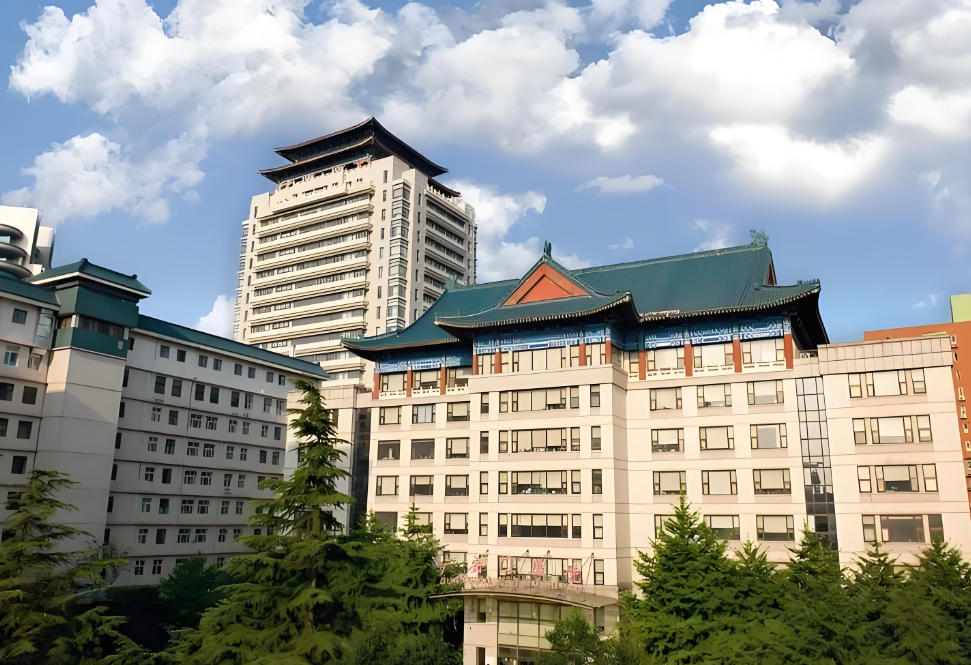
Guang'anmen Hospital of China Academy of Chinese Medical Sciences (Second Clinical Medical Research Institute of China Academy of Chinese Medical Sciences) ✓ Certified partner hospital

Beijing · Partner Hospital

Guang'anmen Hospital of China Academy of Chinese Medical Sciences (Second Clinical Medical Research Institute of China Academy of Chinese Medical Sciences)

The hospital is among the first batch of "mentor-type" national TCM medical center creation units, national regional medical center export units, and national TCM inheritance and innovation center construction units. It is a national TCM oncology medical center, a TCM diabetes specialty center, and a TCM anorectal disease specialty center. It is also an ISO9001 quality management certified unit, a member of the WHO Collaborating Centre for Traditional Medicine, a key unit for the national TCM service trade "pilot program," and one of the first national TCM service export bases. It ranks first nationwide in the Fudan University ranking of comprehensive TCM (oncology) departments.

TCM & AcupunctureRehabilitation
Request Hospital Matching

Hospital Introduction

1. Historical Origins and Spiritual Inheritance

Guang'anmen Hospital of the China Academy of Chinese Medical Sciences (also known as the Second Clinical Medical Research Institute of the China Academy of Chinese Medical Sciences) was founded in December 1955. It is one of the first large-scale national public TCM hospitals established after the founding of the People's Republic of China under the care of the Party Central Committee. It will celebrate its 70th anniversary in 2025. The hospital is hailed as the "national team of TCM," upholding the motto of "Integrity, Benevolence, Harmony, and Scientific Development." It boasts a distinguished collection of renowned doctors and a profound cultural heritage. It serves as a healthcare base for central government officials, a national model TCM hospital, a designated hospital for the Beijing Olympic and Paralympic Games, and has been recognized as a National Civilized Unit. The hospital has witnessed the historical development of TCM in the People's Republic of China and has remained at the forefront of TCM inheritance and innovation for 70 years.

2. Overall Scale and Hardware Capabilities

Located at No. 5 Beixiange, Xicheng District, Beijing, the hospital covers an area of approximately 35,000 square meters, with a building area of approximately 86,028 square meters and a business area of approximately 66,626 square meters. It also has a south wing and other practice areas. The hospital is a Grade III Class A traditional Chinese medicine hospital integrating medical treatment, teaching, scientific research, and preventive healthcare. It boasts a complete range of disciplines, including a number of nationally renowned departments such as oncology, endocrinology, and acupuncture. It is a national clinical research base for traditional Chinese medicine and a national drug clinical trial institution, possessing a complete platform for clinical research in traditional Chinese medicine and the evaluation of new Chinese herbal drugs.

3. National Ranking and Authoritative Certification

The hospital is among the first batch of "mentor-type" national TCM medical center creation units, national regional medical center export units, and national TCM inheritance and innovation center construction units. It is a national TCM oncology medical center, a TCM diabetes specialty center, and a TCM anorectal disease specialty center. It is also an ISO9001 quality management certified unit, a member of the WHO Collaborating Centre for Traditional Medicine, a key unit for the national TCM service trade "pilot program," and one of the first national TCM service export bases. It ranks first nationwide in the Fudan University ranking of comprehensive TCM (oncology) departments.

4. Core Business Data

The hospital ranks among the top TCM hospitals nationwide in terms of annual outpatient and emergency visits, inpatient discharges, and TCM non-drug therapy services. Patients come from all over China and overseas, and the scale of specialized diagnosis and treatment for diseases such as oncology, diabetes, anorectal diseases, endocrinology, dermatology, and urology is enormous. The hospital undertakes numerous national research projects in areas such as standardized TCM oncology treatment programs, TCM prevention and treatment of diabetes, and minimally invasive anorectal diseases and characteristic TCM therapies.

5. MDT Multidisciplinary Collaboration System

The hospital primarily utilizes traditional Chinese medicine (TCM) combined with Western medicine. It has established a multidisciplinary treatment model integrating TCM and Western medicine for specific diseases such as cancer, diabetes, and anorectal diseases. This model organically combines TCM's syndrome differentiation and treatment, focusing on strengthening the body's resistance to cancer, with surgery, radiotherapy, chemotherapy, targeted therapy, and immunotherapy. In the field of oncology, a comprehensive management team, centered on the TCM Oncology Medical Center and comprised of surgeons, radiotherapy specialists, pathologists, imaging specialists, and rehabilitation specialists, provides patients with integrated solutions from treatment to rehabilitation.

6. International and Foreign-Related Medical Treatment System

The hospital is a member of the WHO Collaborating Centre for Traditional Medicine, one of the first national export bases for traditional Chinese medicine services, and a key unit in the national pilot program for trade in traditional Chinese medicine services. It has long been dedicated to promoting traditional Chinese medicine overseas and serving international patients and trainees. Relying on the international academic network of the China Academy of Chinese Medical Sciences, the hospital conducts extensive international cooperation in acupuncture, oncology, diabetes, and other fields, with its traditional Chinese medicine services reaching multiple countries and regions.

Key Departments

Explore the Clinical Focus and Capabilities of This Hospital's Key Departments

Department Profile

Traditional Chinese Medicine (TCM)

The Department of Oncology at Guang'anmen Hospital of the China Academy of Chinese Medical Sciences was established in 1963, pioneered by predecessors such as Yu Guiqing, Duan Fengwu, and Zhang Daizhao. It is one of the earliest TCM oncology specialties in China. The department is currently a national (TCM) oncology medical center (under guidance category in 2021), a national regional TCM oncology treatment center, a key discipline/specialty of the State Administration of Traditional Chinese Medicine, the chairman unit of the Oncology Branch of the China Association of Traditional Chinese Medicine, the president unit of the Oncology Professional Committee of the World Federation of Chinese Medicine Societies, and the chairman unit of the International Alliance of TCM Oncology. It is hailed as the "national team" of TCM oncology. With "strengthening the body's resistance and integrating Chinese and Western medicine" as its core philosophy, the department takes the whole-cycle prevention and treatment of malignant tumors with traditional Chinese medicine as its landmark advantage and positions itself as the core source of clinical, scientific and talent training in oncology in China.

Historical Origins and Spiritual Inheritance:

In 1963, pioneers such as Yu Guiqing, Duan Fengwu, and Zhang Daizhao established the department, making it one of the earliest TCM oncology departments in the country. From its initial outpatient clinic to the establishment of inpatient wards in 1974, and now to its current status as the hospital's largest department with 5 wards, 200 beds, and nearly 300,000 outpatient visits annually, the department has developed into a national-level TCM and integrated TCM-Western medicine oncology discipline that integrates medical treatment, teaching, and research, thanks to the continuous efforts of four generations of experts over the past 62 years. The department pioneered the "strengthening the body's resistance and nourishing the root" approach to tumor treatment, leading national research. Later, under the leadership of professors Lin Hongsheng, Hua Baojin, and Hou Wei, the academic thought of "consolidating the foundation and clearing the source" was formed. Professor Hua Baojin further proposed the theory of "regulating qi and detoxifying," completing the extension of the focus of understanding from "deficiency of the body's resistance" to "excess of pathogenic factors." As the current dean, Professor Li Jie has innovatively proposed a five-stage dialectical system of "deficiency-cold-toxin-closure-decay" based on the core pathogenesis evolution of malignant tumors throughout their entire life cycle.

Core business operational efficiency:

The department currently has 200 beds, with nearly 300,000 outpatient visits and over 3,500 inpatient discharges annually. It boasts 8 doctoral supervisors and 14 master's supervisors, including 1 nationally renowned TCM doctor, 2 Beijing renowned TCM doctors, and 2 national TCM clinical talents. It has trained over 100 master's and doctoral students and over 30 postdoctoral fellows. As a clinical trial institution for oncology drugs designated by the National Medical Products Administration, it has conducted 43 clinical trials of new anti-cancer TCM drugs and independently developed a series of in-house formulations, including Xihuang Jiedu Capsules, Lung Tumor-Smoothing Ointment, Fuzheng Jiedu Oral Liquid, Jianpi Yishen Granules, and Ruanjian Xiaoliu Tablets.

Discipline Positioning and Benchmarking:

The department is a founding unit of the National (Traditional Chinese Medicine Oncology) Medical Center (2021), a National Regional Traditional Chinese Medicine Oncology Diagnosis and Treatment Center (2017), a Key Research Laboratory of Traditional Chinese Medicine Oncology of the State Administration of Traditional Chinese Medicine (1996), and a Level III Laboratory of Tumor Cell Biology (2003). The department spearheaded the development of TCM diagnosis and treatment guidelines for 10 common malignant tumors and the "WHO Western Pacific Region Clinical Guidelines for Evidence-Based Medicine in Traditional Chinese Medicine (Lung Cancer)." It also organized the compilation of my country's first "Clinical Diagnosis and Treatment Guidelines for Tumors in Traditional Chinese Medicine" and promoted it in English, filling a gap both domestically and internationally. The department has received two second-class National Science and Technology Progress Awards and three first-class Science and Technology Progress Awards from the China Association of Traditional Chinese Medicine and the China Association of Integrative Medicine. In terms of international benchmarking, the department has collaborated with the US NCI, Mayo Clinic, and Memorial Sloan Kettering Cancer Center to jointly train more than 10 doctoral (postdoctoral) doctors, and the results have been promoted to 32 countries in Japan, South Korea, Asia, Africa, Europe and the United States.
Next Step

Is this hospital right for you?

Submit diagnosis, treatment history, and goals; hospitals and specialists recommend a formal case assessment.

Contact our service team