
Patient records
Name: Sophie
Age: 65
Nationality: Thailand
Diagnosis: Post-ischemic stroke sequelae (right middle cerebral artery supply area), Wernicke aphasia, right hemiplegia.
Treatment Hospital: Neurorehabilitation Center, Huashan Hospital Affiliated to Fudan University
Case Study Theme: For overseas patients, the biggest obstacles to cross-border medical treatment are often not distance, but rather "information asymmetry" and "culture shock." They don't know how China's healthcare system works, which specialist is best suited for them, or how to build trust with doctors in an unfamiliar language environment. Sophie's story is a microcosm of how we, as a health management company, systematically address these issues.
1. An email from Thailand
When we first received the email from Sophie's daughter, the attachments were filled with discharge summaries, imaging reports, and rehabilitation assessments from the Thai hospital. The email itself was only a few lines long: "My mother is a painter. After her stroke, she can no longer speak or paint. We've been in Thailand for three months of rehabilitation, but progress is very slow. I've heard that acupuncture in China is effective for post-stroke aphasia. Is that true? Where should we go?"
This email encapsulates the typical experience of many overseas patients' families: they hold onto a vague hope, yet don't know how to transform it into a clear path. Our medical case manager's first step wasn't to directly answer "where to go," but rather to initiate a "needs deconstruction." We spent three days conducting multiple video conferences with Sophie's daughter, accomplishing three things: first, we compiled the English medical records into a structured "Summary of Pre-treatment Assessment in China," clarifying the core issues as "sensory aphasia (Wernicke's aphasia)" and "right-sided hemiplegia"; second, we frankly explained that acupuncture is an effective adjunct therapy, but by no means a magic bullet that "makes you speak with a single needle," and that China's advantage lies in its integrated approach of "acupuncture + modern speech therapy + occupational therapy"; and third, we learned that Sophie's inability to express herself had led to severe depression, a significant obstacle to recovery, and we conveyed this crucial information to the assigned medical team in advance.
2. Act as a "converter" between patients and the healthcare system.
After Sophie and her family decided to come to China, our "closed-loop on-the-ground service" began to operate. At the core of this closed loop, we acted as a "converter" between patients and China's complex medical system.
Instead of simply sending her to the "best hospital," we focused on her core need—aphasia rehabilitation—and matched her with the Neurorehabilitation Center at Huashan Hospital affiliated with Fudan University. This center has extensive experience in "Chinese aphasia rehabilitation" and "acupuncture for brain awakening." We explained our selection logic to her family: the tonal characteristics of Chinese stimulate the auditory cortex of the brain in a completely different way than those of Thai. This "novel" stimulation could be a unique tool to activate her damaged language center.
We submitted the Pre-Assessment Summary and Expectation Communication Memorandum to the expert team a week in advance. This meant that when Sophie first met her doctor, the doctor already had a thorough understanding of her condition, psychological state, and recovery goals. The consultation didn't begin with "What's your name?" but with "Ms. Sophie, we understand you are a painter, and we'd like to help you pick up your paintbrush again." This prepared respect is key to building trust between cross-border doctors and patients. Our Thai-Chinese bilingual coordinator not only provided accurate translation during treatment but also helped her understand Chinese hospital procedures, food culture, and even accompanied her to a Chinese art supply store in her daily life. When Sophie felt anxious in unfamiliar environments, she knew there was a professional she could turn to for help at any time.
3. From "Awakening the Mind" to "Ink and Wash Painting"
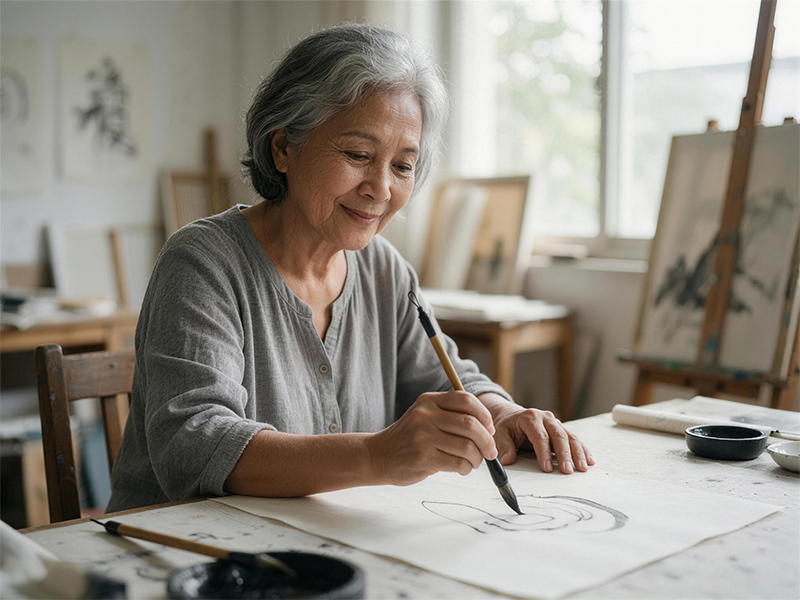
Over the next four months, Sophie underwent intensive integrative rehabilitation. Traditional Chinese medicine experts used acupuncture to "awaken the brain and open the orifices" to improve her cognitive and language functions; a speech therapist used Mandarin tone training to reactivate her auditory-semantic connections; and an occupational therapist introduced traditional Chinese calligraphy and painting into her hand function training, allowing her to regain control of her limbs while practicing "central brushstrokes."
Four months later, Sophie was not only able to have simple daily conversations, but she could also use her left hand to assist her right hand in drawing ink-wash lines full of oriental charm. Her daughter wrote in a thank-you letter: "You didn't give my mother a miracle, but you gave her a path to a miracle. More importantly, you made that path no longer lonely and scary."
In conclusion, Sophie's story demonstrates that for overseas patients, China's value lies not only in its medical technology but also in its unique integrative medical system. Our value lies in acting as the "navigator" and "translator" of this system, ensuring that every patient can safely and with dignity reach their place of hope.