
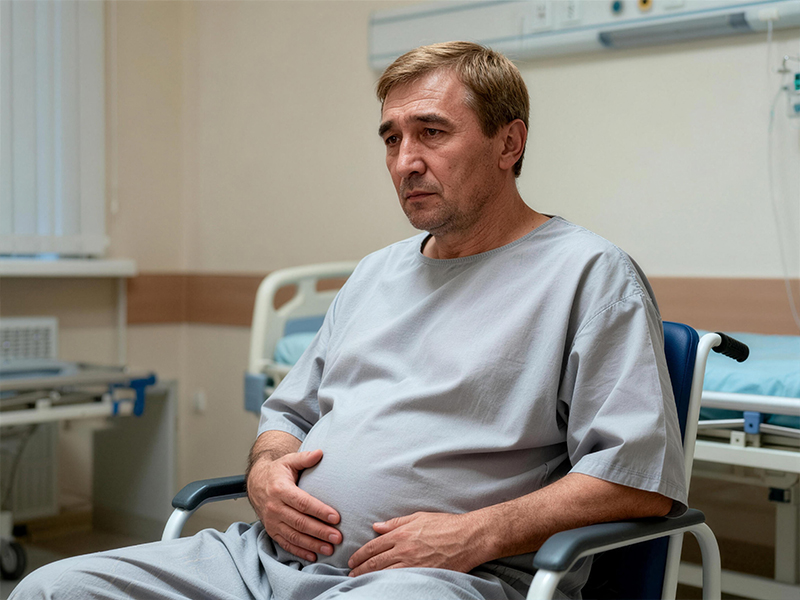
Patient records
Name: Viktor
Age: 55
Nationality: Kazakhstan
Diagnosis: Giant recurrent incisional hernia (hernial ring defect diameter 18cm), abdominal wall insufficiency, and failure of multiple mesh repair surgeries.
Treatment Hospital: Shanghai Ninth People's Hospital Affiliated to Shanghai Jiao Tong University School of Medicine
For patients with complex abdominal wall hernias, the deepest despair is not the huge bulge in their abdomen, but the fact that after repeated surgical repairs, the hernia reappears in another place, like playing whack-a-mole. Viktor's story begins with this kind of despair.
1. An abdomen that has been repeatedly "repaired"
Viktor is a truck driver in Almaty, Kazakhstan. Three years ago, he suffered a ruptured intestine in a car accident and underwent emergency exploratory laparotomy. Post-surgery, the incision became infected and healed poorly, eventually forming a large incisional hernia. Initially, he only felt a soft lump in his abdomen, which he could push back in when lying down. But over time, the lump grew larger, reaching a diameter of 18 centimeters, hanging in his abdomen like a football, making it impossible for him to bend over, drive, or even stand normally.
He underwent two patch repair surgeries in Kazakhstan and Russia. The first time, a regular polypropylene patch was used, but the hernia recurred less than a year later. The second time, doctors attempted a laparoscopic composite patch repair, but six months later, the patch developed severe adhesions to the intestines in his abdominal cavity, leading to chronic pain and intestinal obstruction, and the hernia recurred again. His abdomen has become a "battlefield of surgery," covered with crisscrossing scars.
His attending physician told him, "Your abdominal wall is like a worn-out garment with too many patches; there's no room left to sew new ones. We suggest you consider going abroad to find an expert who can perform 'abdominal wall reconstruction'."
2. Our Value: Finding the answer to "reconstruction" between "repair" and "abandonment".
When Viktor contacted us through a patient support organization in Kazakhstan, his request was very clear: "I've heard that there's a technology in China that doesn't use patches to 'patch' holes, but rather 'relaxes' and 'reconstructs' the entire abdominal wall muscles. Is this true?"
As a health management company, our core value lies in providing patients with evidence-based decision support amidst this information asymmetry. After receiving his thick Russian medical records, we did three things:
First, Condition analysis and treatment plan matching . We compiled all his CT images, surgical records, and patch material information into a "Pre-consultation Summary for Complex Abdominal Wall Hernias." The core conclusion was that his problem was no longer a simple "hernial ring defect," but rather "abdominal wall dysfunction"—due to multiple surgeries and patch infections, his abdominal wall muscles had atrophied, become fibrotic, and lost their normal tension. This was precisely the indication for "Cranial Tissue Separation Technique (CST)" and "abdominal wall reconstruction." We matched him with a leading center in abdominal wall surgery in China—Shanghai Ninth People's Hospital affiliated with Shanghai Jiao Tong University School of Medicine. This center has the largest number of cases and the best treatment outcomes globally in the application of "Transversus Abdominis Release (TAR)" for complex abdominal wall reconstruction.
Second, Honest Expectations Management. Before the remote video consultation, we had an in-depth pre-consultation with Viktor and his family. We clearly stated: "TAR surgery is a major reconstructive surgery, not a simple repair. It requires separating and releasing the muscle layers on both sides of your abdomen, then pulling them together and suturing them in the middle to reconstruct a completely new, functional abdominal wall. The surgery is invasive and has a long recovery period, but the goal is to restore your normal abdominal function and appearance. We cannot promise zero risk, but we can promise that you will receive full-process management from the world's top team in this field."
Third, Full-process support and life reconstruction. After Viktor arrived in China, our Russian-speaking coordinator accompanied him throughout the preoperative assessment, surgery, and postoperative rehabilitation. The TAR surgery was very successful, and his abdomen returned to a flat and firm state. Postoperatively, we connected him with a physical therapist at the hospital and developed a detailed abdominal core muscle rehabilitation training plan to help him gradually regain normal mobility .
3. Post-diagnosis services and follow-up: Safeguarding long-term function after "reconstruction"
After Viktor returned to his home country, our post-operative care system began operating. We established a "Remote Follow-up Record After Abdominal Wall Reconstruction Surgery" for him, with the core task of monitoring the recovery of abdominal wall function and preventing long-term recurrence .
Every month, we collect his abdominal symptom diary through a remote follow-up platform, including pain scores, activity level assessments, and photos of his abdominal appearance.
Each quarter, we coordinate for him to undergo an abdominal ultrasound examination at a local hospital to assess the thickness and integrity of the abdominal wall muscles, and then share the results with experts in China.
Once any abnormalities are detected, such as localized swelling, worsening of chronic pain, or signs of patch infection, we will immediately activate the alert and assist him in contacting Chinese experts for remote evaluation.
4. Therapeutic Effects and Insights
One year after the surgery, Viktor's abdomen was completely flat, and he returned to his job as a truck driver. In a thank-you video he sent us, he said, "What you did for me wasn't just another 'fix,' it was a complete 'reconstruction.' I can finally stand up straight and drive again. Thank you for helping me regain my dignity as a man."