
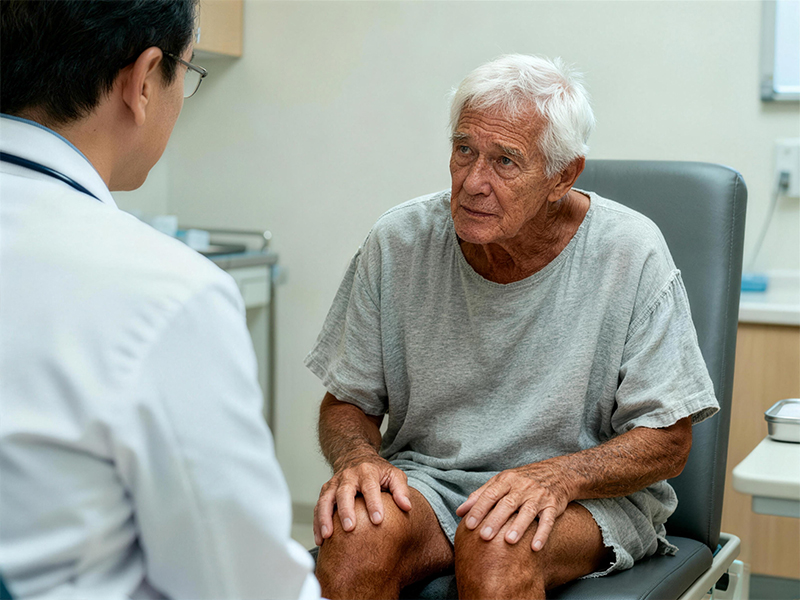
Patient records
Name: George Thompson
Age: 72 years old
Nationality: Australia (Sydney)
Diagnosis: Severe osteoarthritis of both knees (Kellgren-Lawrence grade IV, varus deformity, flexion contracture)
Treatment Hospital: Peking University Third Hospital - Institute of Sports Medicine/Surgery Department
Mr. George is an avid surfer who, even in his seventies, still longs to ride the waves again. However, severe osteoarthritis in both knees has pinned him to the beach. His knee cartilage is almost completely worn away, with bone rubbing against bone, resulting in severe varus deformity of both knees, transforming him into "O-shaped legs." Every step feels like walking on knives, and the pain keeps him awake at night. In Australia, doctors recommended bilateral knee replacement surgery, but traditional surgery requires two procedures, has a long recovery period, and the accuracy of postoperative alignment is uncertain.
When Mr. George's family approached us, his greatest wish was to "stand up as soon as possible and as well as possible." After assessing his situation, our case manager focused on Peking University Third Hospital. Its Institute of Sports Medicine and Department of Joint Surgery are the birthplace of joint replacement and sports rehabilitation in China, and they are particularly adept at combining precise surgery with rapid rehabilitation.
We connected with the expert team at Peking University Third Hospital , importing detailed gait analysis and full-length lower limb X-ray data into the hospital's computer navigation system. This allowed us to precisely calculate the force line angle, osteotomy amount, and prosthesis model for his lower limbs. Our medical consultant explained to him, "This computer navigation technology is like equipping a scalpel with 'GPS,' helping doctors to pinpoint the location accurately and in real time during surgery, placing the artificial joint in the most ideal position and restoring the normal force line of your lower limbs. This not only extends the lifespan of the prosthesis but also makes your walking posture more natural."
The hospital's surgical team decided to take on a challenging task and perform simultaneous bilateral knee replacements on Mr. George. With the aid of computer-guided navigation, the surgeon precisely performed the osteotomy and soft tissue balancing, perfectly implanting two custom-made artificial joints. The day after surgery, with the help of pain management and rehabilitation therapists, Mr. George was able to stand up with the aid of a walker. Looking at his straightened legs in the mirror, he was as excited as a child.
Following the surgery, we implemented a rigorous ERAS (Enhanced Recovery After Surgery) program for him as instructed by the doctor . After returning home, he used our app to record his daily steps and joint range of motion. Our therapists regularly video-chatted with him to guide him in muscle strengthening exercises and gait adjustments. Three months later, Mr. George sent us a video of himself standing on Bondi Beach in Sydney. Although he couldn't surf yet, he could already walk steadily on the sand without his crutches. He said, "I feel like my knees are 20 years younger, and I'm back on the waves in no time!"