
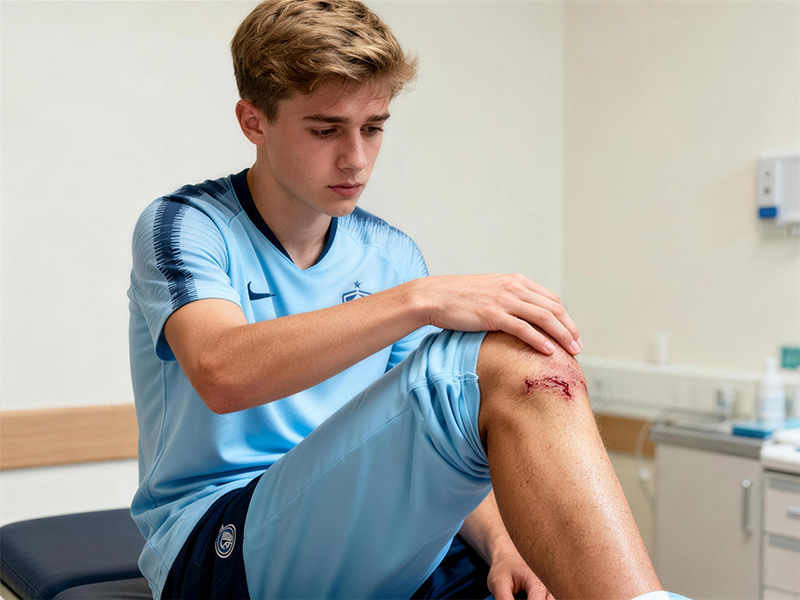
Patient records
Name: Lucas Martin
Age: 19
Nationality: France (Lyon)
Diagnosis: Complete rupture of the anterior cruciate ligament in the right knee combined with a bucket-handle tear of the medial meniscus.
Treatment Hospital: Department of Sports Medicine, Huashan Hospital Affiliated to Fudan University
Lucas was a rising star for Lyon's youth football team, dreaming of becoming a professional player. However, during a crucial qualifying match, a sudden stop and change of direction resulted in a loud thud, and his right knee instantly swelled up, the excruciating pain rendering him unable to stand. An MRI revealed a devastating blow: a complete rupture of the anterior cruciate ligament, combined with a bucket-handle tear of the medial meniscus. In France, doctors recommended surgery, but told him that even if the surgery was successful, returning to his pre-injury level would be a long and uncertain process. For a young man who considered football his life, this was undoubtedly a devastating blow.
Lucas's father found us through a friend, eager to find the safest and fastest path to recovery for his son. Our case manager understood that for an elite athlete, the success of ligament reconstruction depends on the precision of the surgery and the systematic nature of the rehabilitation. We quickly identified the Department of Sports Medicine at Huashan Hospital affiliated with Fudan University as his preferred choice, a prestigious institution in Chinese sports medicine that has provided medical care for countless Olympic champions and national team athletes.
Before the consultation, we arranged a remote consultation with sports medicine experts from Huashan Hospital. Using the MRI images we transmitted, the experts accurately determined the location of the ligament rupture and the type of meniscus tear. Our medical consultant explained to Lucas, “The doctors will use anatomical reconstruction techniques, employing your own tendons to precisely reconstruct a new ligament in the original location, restoring rotational stability to the knee joint. At the same time, they will make every effort to suture the torn meniscus, preserving this important ‘cushion.’”
The surgery was performed arthroscopically. The surgeon made only a few small incisions in Lucas's knee joint, precisely clearing the torn ligament fragments under clear visualization, creating bone tunnels between the femur and tibia, and then perfectly implanting and securing the woven autologous tendon. He then patiently sutured and repositioned the torn meniscus stitch by stitch. Throughout the entire procedure, our case manager was outside the operating room, providing real-time updates to Lucas's parents.
Post-treatment follow-up was crucial in determining Lucas's return to the track. Following medical advice , we developed a detailed 12-month, four-phase rehabilitation plan for him. After returning to China, Lucas uploaded weekly training videos through our app, including exercises on joint range of motion, muscle strength, balance, and agility. The rehabilitation team at Huashan Hospital remotely assessed his progress and dynamically adjusted the plan for the next phase. Nine months after surgery, when he passed rigorous functional tests and was confirmed to be able to return to the track, he cried tears of joy. He said, " You helped me find the best solution; Chinese doctors repaired my broken dream."