
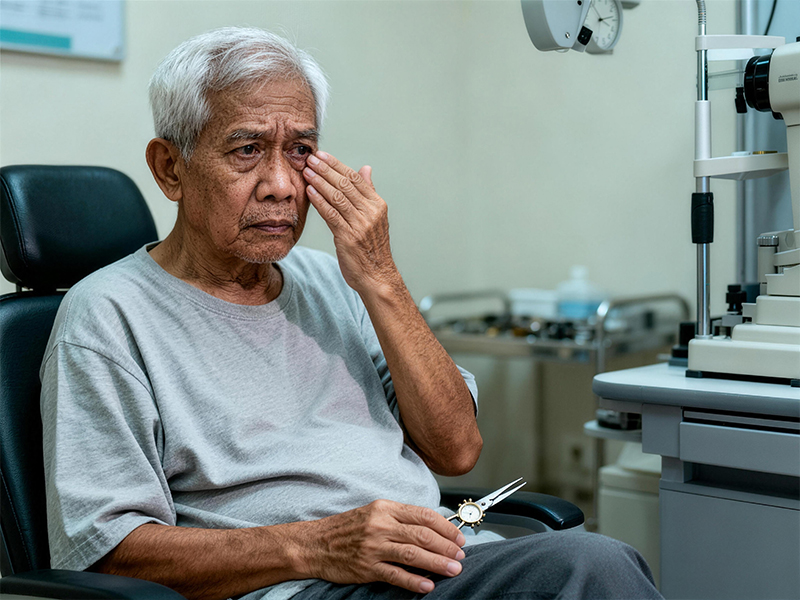
Patient records
Name: Arif bin Ismail
Age: 58
Nationality: Malaysia
Diagnosis: Rhegmatogenous retinal detachment (macular involvement)
Treatment Hospital: Zhongshan Ophthalmic Center, Sun Yat-sen University (Guangzhou)
Arif, 58, from Kuala Lumpur, Malaysia, is a watch repairer. His world consists of intricate gears and delicate hairsprings, requiring exceptional vision. However, a week ago, a fixed black shadow suddenly appeared in his right eye's field of vision, like a giant curtain obscuring half the sky. A local ophthalmologist diagnosed him with rhegmatogenous retinal detachment, which had already affected the macula, and told him he needed surgery as soon as possible, or he would lose his sight permanently. But the local surgery schedule was three weeks long, and his vision was deteriorating by the hour.
Racing against time, precise triage and rapid response: Arif's son contacted us urgently through a friend. Within 15 minutes of receiving the inquiry, our medical team activated the "Ophthalmological Emergency Green Channel." Our health consultant quickly collected Arif's fundus photographs and OCT scan reports, translating and compiling them into a Chinese medical record summary. We knew that for retinal detachment involving the macula, every day of delay negatively impacts the prognosis of postoperative vision recovery. Instead of simply providing a list of hospitals, based on the urgency of his condition and the high demands for precise vision, we precisely targeted the Department of Fundus Surgery at Zhongshan Ophthalmic Center of Sun Yat-sen University. We explained to Arif that the experts at Zhongshan Ophthalmic Center use minimally invasive vitrectomy combined with internal limiting membrane peeling to handle such complex retinal detachments. This technique operates at the micrometer scale, not only repositioning the retina but also minimizing traction and damage to the macula, preserving the best possible chance for the recovery of his precious central vision. Within an hour, we coordinated an emergency remote consultation with an expert, clarifying the surgical plan and the immediate hospital admission procedures upon arrival in Guangzhou.
with seamless, comprehensive medical support . Our ground service specialist was already waiting at the airport, and a private car took him directly to the hospital's VIP ward, skipping the tedious outpatient queues and registration process. On the day of admission, we had already completed all the formalities and accompanied him through his pre-operative examinations. Our medical consultant explained the surgical procedures and post-operative precautions to him in detail in his familiar language, alleviating his anxiety. The surgery was performed by a leading expert in the field and went very smoothly. Post-operatively, we arranged for 24-hour professional care to ensure he strictly maintained a prone position, which is crucial for post-operative recovery. Our case manager communicated with his attending physician daily regarding his condition's progress and kept his family in Malaysia informed in real time.
Cross-border Continuing Health Management: After Arif was discharged from the hospital and returned home, our services did not end. Following his doctor's orders , we developed a detailed post-operative rehabilitation plan for him, including the proper use of eye drops, postural requirements, and a schedule of follow-up appointments. Our health consultant conducted online follow-ups with him one week, one month, and three months post-surgery, answering his questions and guiding him to send us the fundus images from his local follow-up examinations, which we then forwarded to experts at Zhongshan Ophthalmic Center for remote evaluation. Six months later, Arif's corrected visual acuity in his right eye recovered to 0.8. He sent us a video; in the video, he was steadily picking up a gear smaller than a sesame seed with tweezers, saying to the camera, "You not only saved my eyes, but you also saved my world. Thank you for helping me refocus my life."