
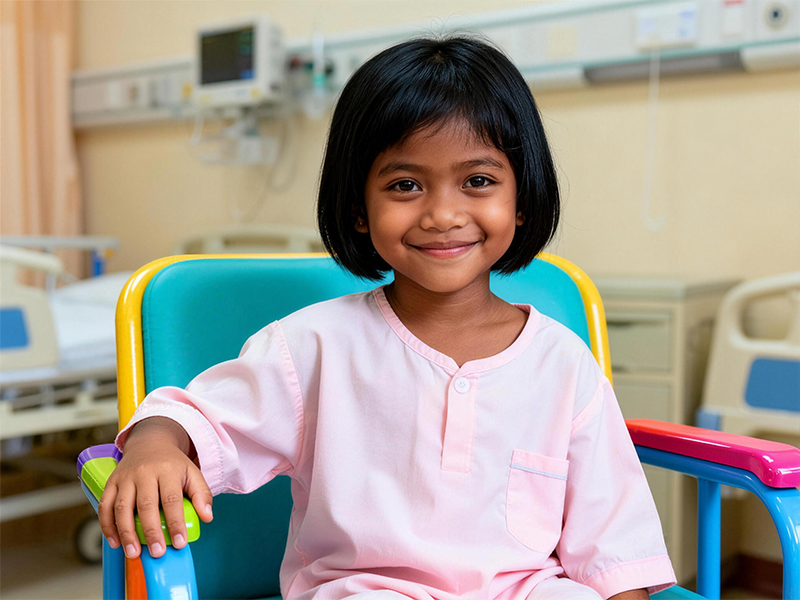
Patient records:
Name: Dara
Age: 5 years old
Nationality: Cambodia
Diagnosis: Congenital right radial paraaxial hemilimb deformity (congenital limb malformation)
Treatment Hospital: Beijing Children's Hospital (Orthopedics), Capital Medical University
From "no thumb" to "regaining syndesmosis," we've given wings to angels.
Five-year-old Dara is from Phnom Penh, Cambodia. She's a cheerful girl, but she was born without a right thumb. Her right hand resembles a small fork, with only four fingers, making it unable to grasp anything. She can only clumsily eat and draw with her left hand. This is a congenital radial paraaxial hemiplegia; the complete absence of the thumb means she has lost 50% of her hand's function. In Cambodia, no hospital can reconstruct a thumb for her, and her life seems destined to be lived with this disability.
Dara's parents found us through an international charity. After reviewing the data and conducting an evaluation, our medical team determined that Dara's condition was ideally suited for pollicization. We promptly recommended Dara to the Department of Orthopedics at Beijing Children's Hospital, affiliated with Capital Medical University. This department is nationally renowned for its treatment of congenital hand and foot deformities in children. Their microsurgical pollicization procedure can transfer and reconstruct the best-developed index finger, along with its blood vessels, nerves, and tendons, into a completely new, sensory, and oppositional thumb—a remarkable and transformative art.
initial service focused on "building confidence." We showed Dara and his family before-and-after photos and videos of several successful cases, allowing them to witness the miracle of "index finger turning into thumb." Simultaneously, we coordinated with the hospital's rehabilitation team to intervene early, using games to train the strength and coordination of Dara's left hand and right upper limb, laying the foundation for post-operative functional reconstruction.
The Dara family arrived in Beijing. Our coordinator accompanied them throughout the procedure. During the surgery, under a high-powered microscope, the doctors meticulously separated the neurovascular bundles of the index finger, rotated, shortened, and repositioned them to the position of the thumb. They also precisely reconstructed the function of the thenar muscles, allowing the new thumb to perform the delicate action of "opposition." The surgery lasted six hours.
In the post-operative phase, successful surgery is only the first step; functional rehabilitation is key. The hand rehabilitation therapist intervened immediately four weeks after the cast was removed. Fun occupational therapy games were designed for Dara, such as playing with clay, picking up beans, and building blocks, to encourage her to actively use her new thumb.
After returning home, we referred her to our partner rehabilitation center in Phnom Penh and provided her with a detailed rehabilitation plan developed by Beijing Children's Hospital. Our rehabilitation consultant conducted a remote video assessment monthly to monitor the quality of her rehabilitation. A year later, when Dara steadily picked up a candy with her new thumb and put it in her mouth, her smile was brighter than the Phnom Penh sunshine.