
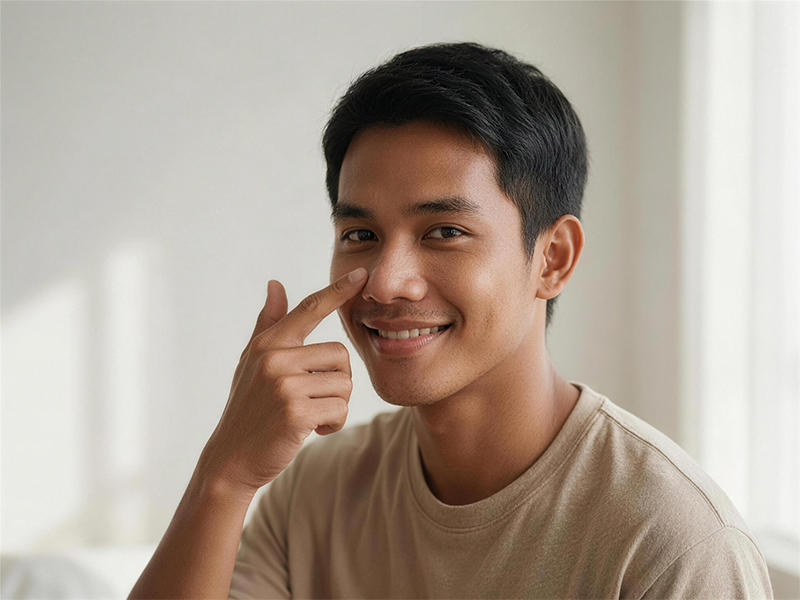
Patient records:
Name: Somsak
Age: 28
Nationality: Thailand
Diagnosis: Post-traumatic nasal defect (partial loss of the nasal alar and columella).
Treatment Hospital: Shanghai Ninth People's Hospital Affiliated to Shanghai Jiao Tong University School of Medicine
They used skin from his forehead to rebuild a "new nose" for him.
Somsak, a 28-year-old motorcycle deliveryman in Bangkok, Thailand, survived a serious traffic accident, but lost half of his nose. The loss of his nasal alar and columella left a shocking "hollow" in the center of his face, disfiguring him and causing him breathing difficulties. He dared not remove his mask, lost his job, and his girlfriend left him. Repairing such facial organ defects is one of the most challenging areas of plastic surgery, requiring complex nasal reconstruction surgery, not just simple suturing.
Somsak found us through a patient support community. After a video evaluation, our medical team determined that his condition was a "subunit nasal defect," requiring full-thickness reconstruction including lining, support structure, and skin coverage. We promptly recommended the Department of Plastic and Reconstructive Surgery at Shanghai Ninth People's Hospital, affiliated with Shanghai Jiao Tong University School of Medicine. This department is a global leader in "forehead flap total nasal reconstruction," capable of culturing forehead skin and meticulously sculpting it into the various subunits of the nose.
In the initial phase of our service, we focused on "rebuilding hope." We explained the surgical procedure to Somsak, showing him how to "cultivate" new skin by implanting an expander under his forehead, and then, like origami, shape it into the tip, wings, and columella of his nose. Simultaneously, we coordinated with a mental health counselor to intervene and help him overcome post-traumatic stress disorder and major depressive disorder.
Somsak arrived in Shanghai. His treatment was conducted in multiple phases. In the first phase, doctors implanted a soft tissue expander in his forehead, and after nearly three months of hydrotherapy expansion, a sufficient area of healthy skin was cultivated. In the second phase, doctors harvested autologous rib cartilage, sculpted it into a framework for the nasal tip and alar cartilage, and meticulously assembled and sutured it to the expanded forehead flap, reconstructing a lifelike nose. Our coordinator accompanied him throughout the process for several months, assisting him with any difficulties he faced in his daily life.
When Somsak first saw his complete, three-dimensional nose in the mirror, he cried with excitement. After the surgery, the therapist guided him on maintaining the shape of his nose and managing scarring. Upon returning home, we established a "long-term follow-up file after nasal reconstruction," regularly tracking the recovery of his nose and the forehead donor area. Using the world-class organ reconstruction technology of the Ninth People's Hospital, we reconstructed the core landmarks of Somsak's face, smoothing over the "battle damage" on his face and in his heart, giving him the courage to take off his mask and start a new life.