West China Hospital of Sichuan University ✓ Certified partner hospital

Chengdu · Partner Hospital

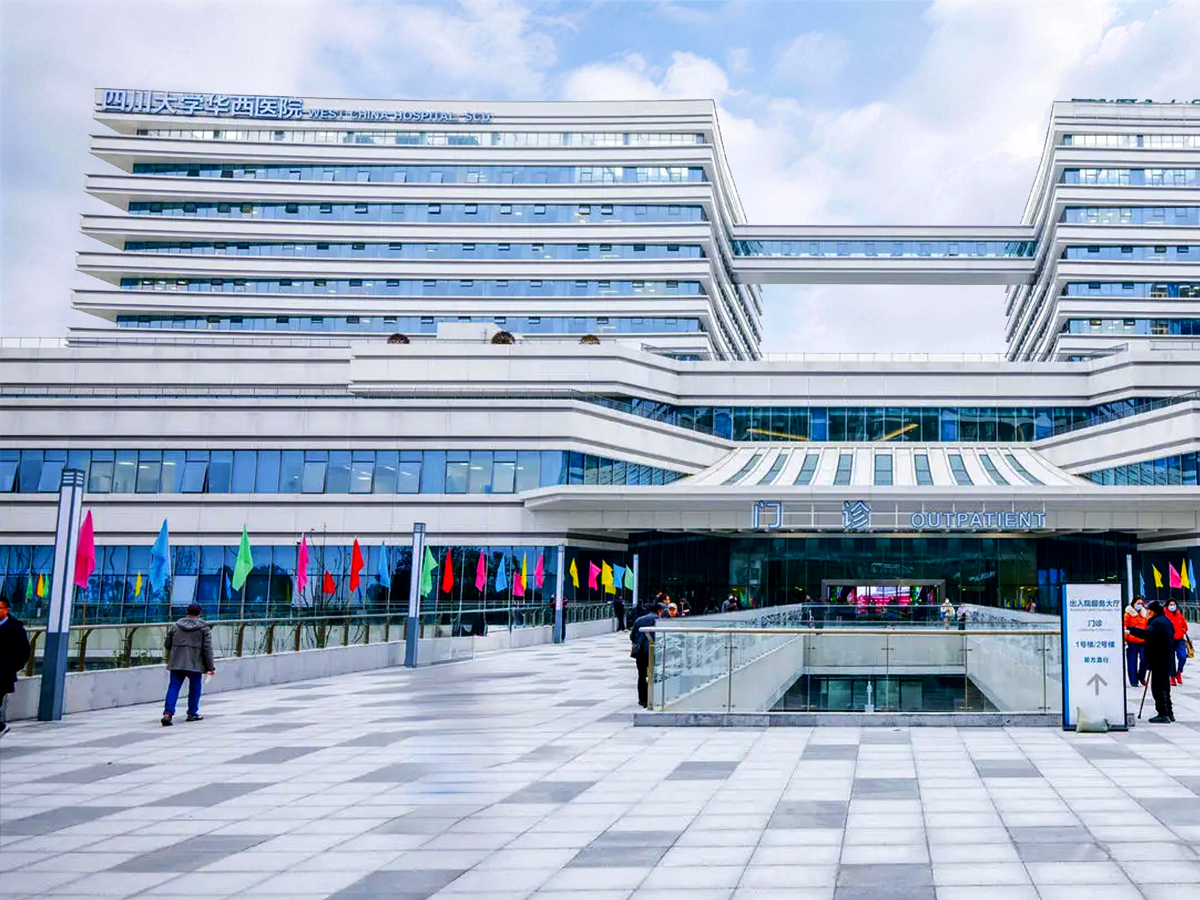
West China Hospital of Sichuan University

The hospital is among the first batch of national medical center construction units and a pilot hospital for high-quality development jointly built by the national and provincial governments. It has established a national medical center for mental illness and two national regional medical centers. The hospital has 43 national key clinical specialties, ranking first among hospitals in China; its clinical medicine ESI ranking is in the top 0.252‰ globally. In the Fudan University version of the China Hospital Ranking, the hospital's comprehensive strength has ranked among the top three in China for many consecutive years (ranking second in the country for 11 consecutive years). Its anesthesiology department ranks first in the country, and many other specialties such as radiology, pathology, urology, ultrasound medicine, and geriatrics are among the top in the country. More than 10 specialties in the hospital are ranked among the top three in the country, and nearly 30 specialties are ranked among the top ten in the country.

Organ TransplantOncologyNeurologyRehabilitationRare & Complex DiseasesInternal MedicineSurgeryOrthopedicsUrologyCardio-CerebrovascularGastroenterologyThoracicHepatobiliary
Request Hospital Matching

Hospital Introduction

1. Historical Origins and Spiritual Inheritance

Founded in 1892, West China Hospital of Sichuan University, whose West China School of Clinical Medicine originated from the West China Union University Medical School in 1914, is the oldest modern medical institution and hospital in western China. With the motto "Cultivating Morality and Professional Excellence, Seeking Truth and Innovation," the hospital has grown into a national-level center for the diagnosis and treatment of complex, critical, and severe illnesses in western China after more than a century of development. The hospital has consistently been at the forefront of responses to major public health emergencies such as the 2008 Wenchuan earthquake and the fight against COVID-19, earning titles such as National Heroic Collective in Earthquake Relief and National Advanced Collective in the Fight Against COVID-19 from the Central Committee of the Communist Party of China, the State Council, and the Central Military Commission. In 2018, it was approved as the only non-military international emergency medical team in the world to receive the highest level of certification from the World Health Organization.

2. Overall Scale and Hardware Capabilities

The hospital directly manages three medical campuses (the main campus in Chengdu Guoxue Lane, the Wenjiang campus, and the fully managed Chengdu Shangjin Nanfu Hospital), covering an area of over 577 acres with 676,200 square meters of business space, 4,900 authorized beds, 54 clinical departments (including 7 specialized disease centers), and over 10,000 employees. The hospital has a 350,000-square-meter integrated medical and research platform, equipped with the world's most advanced diagnostic and treatment equipment, including 11 MRI machines, 11 spiral CT scanners, 6 linear accelerators, 2 PET-ECT scanners, Gamma Knife, and the da Vinci robotic surgical system. It also has 99 standard operating rooms and houses 9 national-level and 55 provincial-level innovative research platforms, including the National Key Laboratory of Biotherapy, the National Key Laboratory of Respiratory and Comorbid Diseases, the National Major Scientific and Technological Infrastructure for Translational Medicine in Biotherapy, and the National Clinical Research Center for Geriatric Diseases.

3. National Ranking and Authoritative Certification

The hospital is among the first batch of national medical center construction units and a pilot hospital for high-quality development jointly built by the national and provincial governments. It has established a national medical center for mental illness and two national regional medical centers. The hospital has 43 national key clinical specialties, ranking first among hospitals in China; its clinical medicine ESI ranking is in the top 0.252‰ globally. In the Fudan University version of the China Hospital Ranking, the hospital's comprehensive strength has ranked among the top three in China for many consecutive years (ranking second in the country for 11 consecutive years). Its anesthesiology department ranks first in the country, and many other specialties such as radiology, pathology, urology, ultrasound medicine, and geriatrics are among the top in the country. More than 10 specialties in the hospital are ranked among the top three in the country, and nearly 30 specialties are ranked among the top ten in the country.

4. Core Business Data

The hospital's peak daily outpatient and emergency visits exceeded 20,000, reaching 4.85 million in 2020. It discharged 238,000 patients annually and performed 164,000 surgeries per year, averaging over 500 surgeries per day. The hospital's CMI value reached 1.77, and over 80% of its patients were diagnosed with complex or difficult-to-treat diseases. The hospital holds leading positions both domestically and internationally in several fields, including adult living donor liver transplantation, lung cancer surgery and minimally invasive treatment, interventional cardiology, neurosurgery and functional neurosurgery, integrated traditional Chinese and Western medicine treatment of severe pancreatitis, minimally invasive gastrointestinal surgery, allogeneic larynx-trachea-thyroid transplantation, clinical anesthesia, functional magnetic resonance imaging (fMRI), and nuclear medicine.

5. MDT Multidisciplinary Collaboration System

The hospital pioneered a multidisciplinary collaborative treatment model in China, offering 79 outpatient multidisciplinary clinics for complex and rare diseases and 27 inpatient MDTs (Multidisciplinary Teams). In 2009, the hospital established a complex disease consultation center, providing multidisciplinary clinics, consultations for difficult cases, and a green channel for major positive results. It also pioneered the "4+X" perioperative risk assessment MDT clinic nationwide and established mature MDT teams for diseases such as hepatic echinococcosis, glioma, and prostate cancer, achieving a "patient-centered" approach and addressing the medical challenges faced by patients with complex, rare, and difficult diseases.

6. International and Foreign-Related Medical Treatment System

In 2018, the hospital was successfully approved as the world's only non-military international emergency medical team certified by the World Health Organization at the highest level. It has long undertaken foreign medical aid missions, demonstrating its national-level capabilities in its missions to Tibet, Xinjiang, Africa, and North Korea. The hospital has extensive academic collaborations with world-class medical centers, established a joint international talent training system, and provides remote continuing medical education to over 2 million people annually through platforms such as the international emergency medical team and telemedicine education. Its international academic influence ranks among the top hospitals in China.

Key Departments

Explore the Clinical Focus and Capabilities of This Hospital's Key Departments

Select a department to view its full profile.

Department Profile

Neurological Rehabilitation

The Rehabilitation Medicine Center of West China Hospital, Sichuan University, is a national key clinical specialty. It serves as the chairman unit of the Physical Medicine and Rehabilitation Branch of the Chinese Medical Association and a vice-chairman unit of the Chinese Association of Rehabilitation Medicine. Its rehabilitation medicine program has consistently ranked first in the nation for many years in Fudan University's ranking of specialized disciplines (ranking first in both specialized reputation and overall ranking in 2022 and 2023). With neurorehabilitation as one of its core advantageous sub-disciplines, it was the first unit in mainland China to offer full-time undergraduate programs in rehabilitation medicine. Its three specialties—physical therapy, occupational therapy, and prosthodontics—have all received international accreditation (WCPT/WFOT/ISPO). The center is positioned as a core source for aligning China's modern rehabilitation medicine education system with international standards and a leader in the rehabilitation of complex and critical illnesses nationwide.

Historical Origins and Spiritual Inheritance:

The history of West China Rehabilitation can be traced back to 1929, when Cunren Hospital began using physical factors to treat diseases. In 1933, American Paul Weir opened a clinical physiotherapy course at West China Union University. In December 1951, West China Union University Hospital established the Department of Physical Therapy and the Department of Occupational Therapy, marking the formal establishment of West China Rehabilitation. In September 1989, the Rehabilitation Medicine Center was officially established. Through the inheritance and development of several generations of academic leaders such as Xiong Enfu and He Chengqi, the center has developed from the initial Department of Physical Therapy into a modern rehabilitation medicine center integrating medical treatment, teaching, research, and production. Professor He Chengqi, as the discipline director, leads a national key clinical specialty, which ranks first in the country at Fudan University. The rehabilitation therapy major at Sichuan University, which he also leads, is ranked A+ in the Soft Science China University Major Ranking and was selected as one of the first batch of national first-class majors.

Core business operational efficiency:

The center has 211 beds and 283 staff members, including 46 senior professionals, 117 master's degree holders, 51 doctoral degree holders, and 35 postdoctoral fellows. The center comprises four wards, twenty-three subspecialties, twelve treatment departments, five research laboratories, and seven specialized centers, forming a distinctive specialty based on specific diseases, oriented towards functional rehabilitation, and centered on rehabilitation technology. The neurorehabilitation section, as one of the center's core subspecialties, covers functional rehabilitation for cerebrovascular diseases, brain injuries, neurocritical care rehabilitation, spinal cord injuries, peripheral nerve injuries, Parkinson's disease, and Alzheimer's disease. The center specializes in the rehabilitation of complex and critical illnesses and provides a systematic specialized learning platform for trainees from all over the country each year.

Discipline Positioning and Benchmarking:

It is a national key clinical specialty, the chairman unit of the Physical Medicine and Rehabilitation Branch of the Chinese Medical Association, the vice-president unit of the Chinese Association of Rehabilitation Medicine, and the director unit of the Sichuan Provincial Key Laboratory of Rehabilitation Medicine. The center possesses several "firsts in mainland China," including the first joint doctoral program in physical therapy, occupational therapy, and prosthodontics. Its rehabilitation medicine program has consistently ranked first in the nation for many years in Fudan University's ranking of specialty reputation, and in 2022, it ranked first in both specialty reputation and overall ranking.

Next Step

Is this hospital right for you?

Submit diagnosis, treatment history, and goals; hospitals and specialists recommend a formal case assessment.

Contact our service team